A Rare Case of Melanotic Neuroectodermal Tumor of Infancy: Histopathological and Immunohistochemical Features
DOI:
https://doi.org/10.21276/apalm.3751Keywords:
melanotic neuroectodermal tumor of infancy, mnti, maxilla, neural crestAbstract
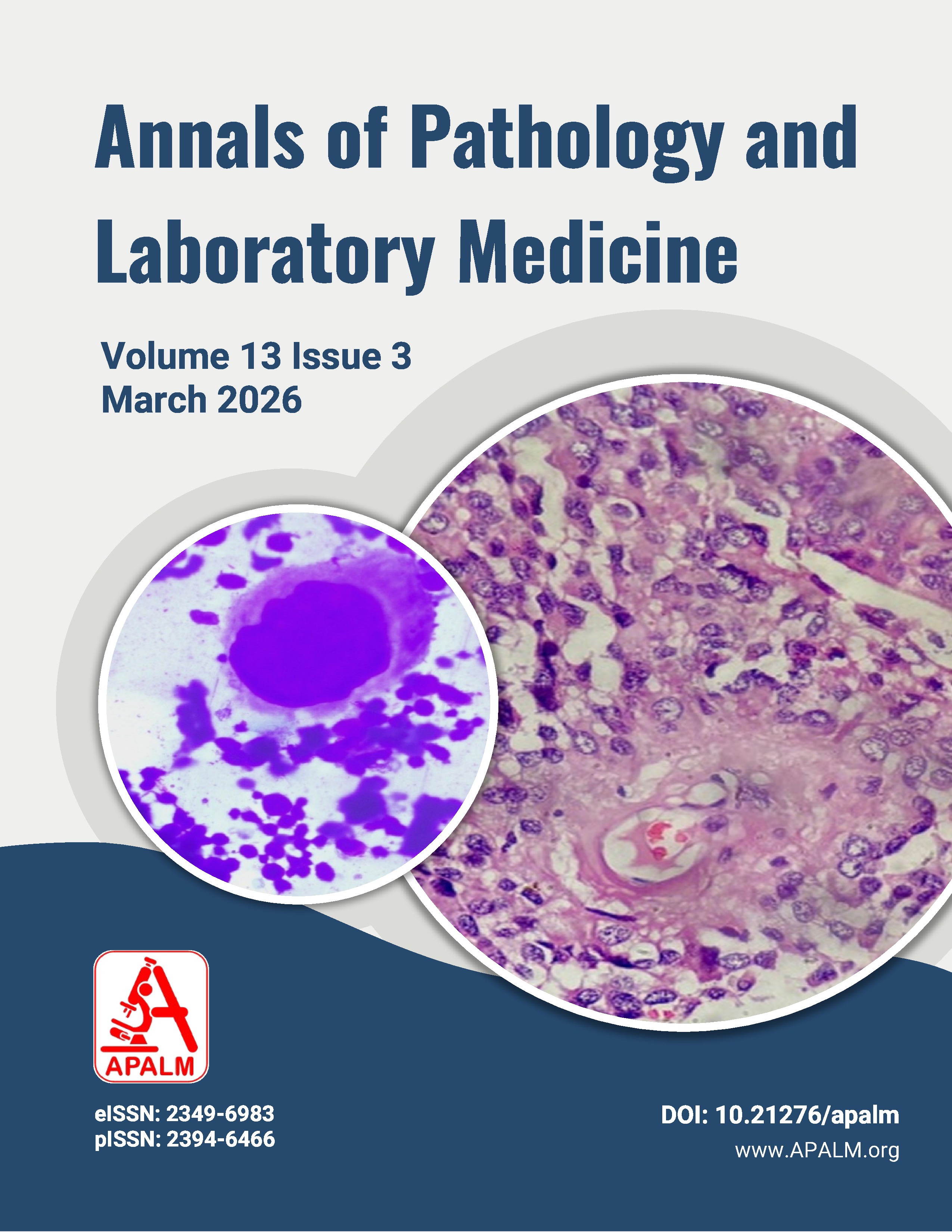
Melanotic neuroectodermal tumor of infancy (MNTI) is a rare, pigmented neoplasm of neural crest origin occurring predominantly in infants under one year of age. Although histologically benign, it exhibits locally aggressive behavior and can mimic malignancy due to rapid growth and bone destruction. Early recognition is essential for appropriate management. Case Report: We present a case of a 3-month-old male infant from Uttar Pradesh who presented with a bluish intraoral swelling involving the left side of the mandible. Computed tomography revealed a well-defined expansile lesion with mild enhancement in the body of left mandible. Serum vanillylmandelic acid (VMA) levels were within normal limits. Histopathological examination showed a biphasic tumor composed of large melanin-containing epithelial-like cells and small neuroblast-like cells arranged in nests and alveolar patterns. Immunohistochemistry demonstrated positivity for HMB-45, CD-99 and synaptophysin whereas S-100, desmin and WT1 were negative. A final diagnosis of melanotic neuroectodermal tumor of infancy was rendered. Complete surgical excision was performed, and postoperative recovery was uneventful. The patient remains under follow-up with no recurrence to date.
MNTI is an uncommon but distinct entity that should be considered in the differential diagnosis of pigmented maxillary swellings in infants. A combination of histopathological and immunohistochemical findings is crucial for accurate diagnosis. Early surgical intervention with adequate margins provides an excellent prognosis.
References
1. Agarwal P, Agarwal I, Raina VK. Melanotic neuroectodermal tumor of infancy: case report of an unusual tumor. Indian J Plast Surg. 2008;41(2):214-216.doi:10.4103/0970-0358.44942
2. Asefa M, Hailu T.Melanotic neuroectodermal tumor of infancy :a case report. J Med Case Rep.2024;18:230.doi:10.1186/s13256-024-04550-y
3. Rachidi S, Sood AJ, Patel KG, Nguyen SA, Hamilton H, Neville BW, et al. Melanotic neuroectodermal tumor of infancy: a systematic review. J Oral Maxillofac Surg. 2015;73(10):1946–1956. doi: 10.1016/j.joms.2015.03.061
4. Surana A, Magalhaes MHCG, Pires FR, de Almeida OP. Clinical and immunohistochemical study of melanotic neuroectodermal tumor of ingancy in the maxilla. Einstein (Sao Paulo). 2018;16(2):Erc4205. Doi:10.1590/S1679-45082018rc4205
5. Sailukar M, Bhagwat R, Seth T. Melanocytic neuroectodermal tumor of infancy. J Indian Assoc Pediatr Surg.2007;12(3):178-179.doi:10.4103/0971-9261.35942
6. Barrett AW, Morgan M, Ramsay AD, Farthing PM, Newman L, Speight PM. A clinicopathologic and immunohistochemical analysis of melanotic neuroectodermal tumor of infancy. Oral Surg Oral Med Oral Pathol Oral Radiol Endod. 2002;93(6):688–698. doi: 10.1067/moe.2002.124000.
7. Cui Y, Mao Z, Liao C. Melanotic neuroectodermal tumor of infancy: a case report and review of the surgical treatment. Oncol Lett. 2015;9(1):29–34. doi: 10.3892/ol.2014.2665.
8. Krishnamurthy A, Vaidhyanathan A, Majhi U. Malignant melanotic neuroectodermal tumor of infancy arising in the mandible. J Cancer Res Ther. 2011;7(3):368–372. doi: 10.4103/0973-1482.87018
9. Dhal l, Lali BS, Chowdhury Z, Saha S. Melanotic neuroectodermal tumor of infancy: a case series and comprehensive review of this rare pediatric neoplasm. Asian Pac J Cancer Biol. 2023;8(3):309-311. doi:10.31557/APJCB.2023.8.3.309-311
10. Tiwari A, Yadav ML. Melanotic Neuroectodermal Tumor of Infancy: A Rare Case Report. Cureus [Internet]. 2019. January 14, 2023at: https://www.cureus.com/articles/26329-melanotic-neuroectodermal-tumor-of-infancy-a-rare-case-report
11. Rachidi S, Sood AJ, Patel KG, et al. Melanotic neuroectodermal tumor of infancy: a systematic review. J Oral Maxillofac Surg 2015;73(10):1946–1956
Downloads
Published
Issue
Section
License
Copyright (c) 2026 Shuchi Ghai, Tanvi Arora, Ajay Malik, Arvind Tyagi

This work is licensed under a Creative Commons Attribution 4.0 International License.
Authors who publish with this journal agree to the following terms:
- Authors retain copyright and grant the journal right of first publication with the work simultaneously licensed under a Creative Commons Attribution License that allows others to share the work with an acknowledgement of the work's authorship and initial publication in this journal.
- Authors are able to enter into separate, additional contractual arrangements for the non-exclusive distribution of the journal's published version of the work (e.g., post it to an institutional repository or publish it in a book), with an acknowledgement of its initial publication in this journal.
- Authors are permitted and encouraged to post their work online (e.g., in institutional repositories or on their website) prior to and during the submission process, as it can lead to productive exchanges, as well as earlier and greater citation of published work (See The Effect of Open Access at http://opcit.eprints.org/oacitation-biblio.html).
How to Cite