Peripheral Neuropathy as the Initial Presenting Feature of ANCA-Negative Eosinophilic Granulomatosis with Polyangiitis: A Case Report
DOI:
https://doi.org/10.21276/apalm.3869Keywords:
eosinophilic granulomatosis with polyangiitis, eosinophilia, peripheral neuropathy, vasculitis, anca-negative vasculitisAbstract
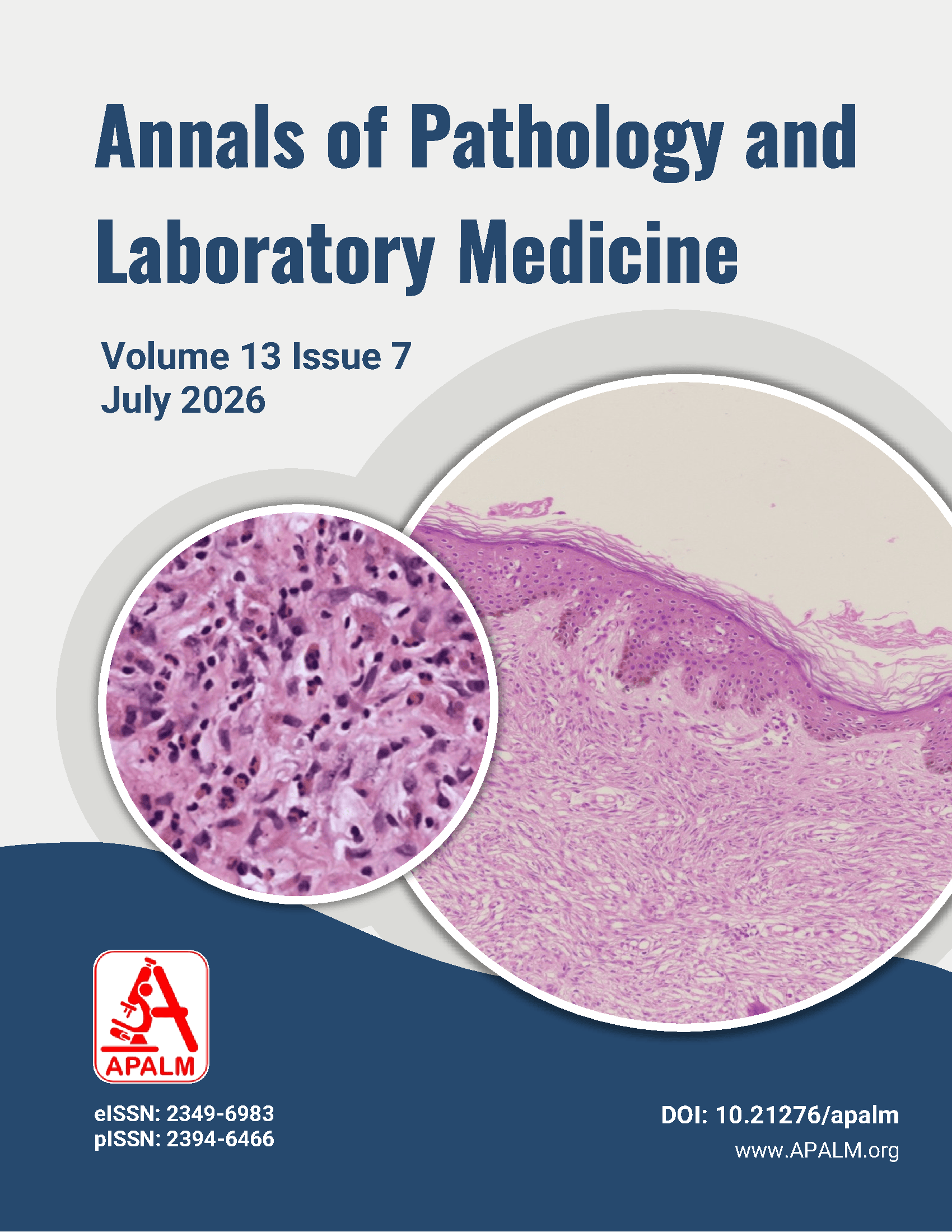
Eosinophilic granulomatosis with polyangiitis (EGPA), previously known as Churg–Strauss Syndrome, is a rare necrotizing vasculitis involving small- to medium-sized vessels, typically associated with asthma and peripheral eosinophilia. Antineutrophil cytoplasmic antibodies (ANCA) are variably present, and ANCA-negative cases often pose a diagnostic challenge. We report a case of a 34-year-old female with a history of recurrent sinusitis since childhood and bronchial asthma, who presented with features of peripheral neuropathy. Laboratory evaluation revealed marked eosinophilia, while ANCA serology was negative. Histopathological examination of sural nerve demonstrated eosinophilic infiltration with vasculitis in perineural tissue, perivascular infiltration by mononuclear cells and eosinophils, fibrinoid necrosis of vessel walls, and loosely formed granulomas. Scattered epithelioid cells were noted, with negative Ziehl–Neelsen and Fite stains for acid-fast bacilli. Based on clinical, laboratory, and histopathological findings, a diagnosis of ANCA-negative EGPA was established. This case highlights the importance of recognizing peripheral neuropathy as an early manifestation and emphasizes the critical role of histopathology in establishing the diagnosis in seronegative cases. Early diagnosis is essential to initiate appropriate therapy and prevent disease progression.References
1. Groh M, Pagnoux C, Baldini C, Bel E, Bottero P, Cottin V, et al. Eosinophilic granulomatosis with polyangiitis (Churg–Strauss): evolution of disease classification, pathogenesis and management. Nat Rev Rheumatol. 2015;11(9):531–542.
2. Kitching AR, Anders HJ, Basu N, Brouwer E, Gordon J, Jayne DRW, et al. ANCA-associated vasculitis. Nat Rev Dis Primers. 2020;6(1):71.
3. Robson JC, Grayson PC, Ponte C, Suppiah R, Judge A, Khalid S, et al. 2022 American College of Rheumatology/EULAR classification criteria for ANCA-associated vasculitis. Ann Rheum Dis. 2022;81(3):315–320.
4. Lanham JG, Elkon KB, Pusey CD, Hughes GR. Systemic vasculitis with asthma and eosinophilia: a clinical approach to the Churg–Strauss syndrome. Medicine (Baltimore). 1984;63(2):65–81.
5. Guillevin L, Cohen P, Gayraud M, Lhote F, Jarrousse B, Casassus P. Churg–Strauss syndrome: clinical study and long-term follow-up of 96 patients. Medicine (Baltimore). 1999;78(1):26–37.
6. Collins MP, Dyck PJ. Vasculitic neuropathies. Curr Opin Neurol. 1999;12(5):573–85.
7. Sinico RA, Bottero P. Churg–Strauss angiitis. Best Pract Res Clin Rheumatol. 2009;23(3):355–66.
8. Bosch X, Guilabert A. Eosinophilic granulomatosis with polyangiitis (Churg–Strauss syndrome). Orphanet J Rare Dis. 2010;5:18.
9. Roufosse F. Hypereosinophilic syndrome variants: diagnostic and therapeutic considerations. Haematologica. 2009;94(9):1188–93.
10. Hellmich B, Sanchez-Alamo B, Schirmer JH, et al. EULAR recommendations for the management of ANCA-associated vasculitis: 2022 update. Annals of the Rheumatic Diseases 2024;83:30-47.
Downloads
Published
Issue
Section
License
Copyright (c) 2026 Charu Kiran Agrawal, Nitin M Gadgil, Chetan Chaudhari

This work is licensed under a Creative Commons Attribution 4.0 International License.
Authors who publish with this journal agree to the following terms:
- Authors retain copyright and grant the journal right of first publication with the work simultaneously licensed under a Creative Commons Attribution License that allows others to share the work with an acknowledgement of the work's authorship and initial publication in this journal.
- Authors are able to enter into separate, additional contractual arrangements for the non-exclusive distribution of the journal's published version of the work (e.g., post it to an institutional repository or publish it in a book), with an acknowledgement of its initial publication in this journal.
- Authors are permitted and encouraged to post their work online (e.g., in institutional repositories or on their website) prior to and during the submission process, as it can lead to productive exchanges, as well as earlier and greater citation of published work (See The Effect of Open Access at http://opcit.eprints.org/oacitation-biblio.html).
How to Cite